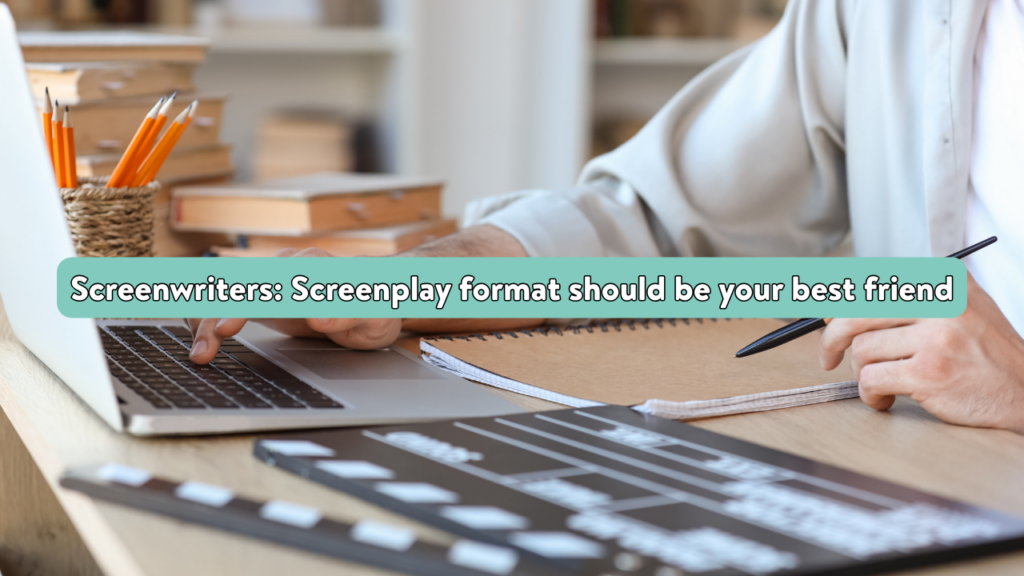
Screenwriters: Screenplay format should be your best friend
If you want to learn how to write a screenplay, learning screenwriting format is a reality. But it can feel daunting, gatekept, and overwhelming. The simple truth is that screenplay format isn’t optional. But, it’s ALSO not just something industry people insist on to torture you.
Screenplay format is the industry standard.
As a screenwriter, your job is to remove as many barriers as possible between your story and the people reading it. In film and television, proper screenplay formatting is incredibly functional. Producers use it to estimate budgets and timelines. Development teams use it evaluate pacing, structure, and readability. Even assistants rely on it.
If your script isn’t in standard format, it won’t just “look different.” It will be difficult to process inside the system that has been built for and around it. Using correct screenplay format removes one of the biggest barriers.
Screenplay format forces visual storytelling.
One of the first things writers need to learn and understand about screenwriting is this:
There is no space in a screenplay for a character’s internal motivations. You cannot write, “She feels conflicted but hopeful.” The format simply doesn’t allow it. And that’s intentional.
Screenplay format enforces (requires!) visual, literal storytelling. If your character is conflicted but hopeful, you must express that through action, behavior, and imagery.
Does she delete the text and rewrite it? Does her hand hover above the doorknob? Does she straighten her jacket, but walk in anyway?
This is also why action lines are written in present tense. Present tense creates immediacy. It controls pacing. It drops the reader directly into what’s happening right now.
The page shows you how well you’re doing.
In screenwriting, less is often more. If you can say something in two words instead of eighteen…do it. Clear, concise action keeps your pages slim and maintains rhythm.
White space on every page matters. Readability matters. Pace lives and dies by the length of your sentences.
When you’re unsure how to format something unusual, prioritize clarity. The goal of screenplay formatting isn’t to impress someone with rule-bending. You need to make your story easy to read so that it’s easy to enjoy.
Your job is to describe the story — not direct the movie.
One of the biggest mistakes new screenwriters make is trying to direct from the page.
You are not the camera. You are not the actor. You are not the cinematographer. Your job is to describe what happens. It’s someone else’s job to capture it.
That means:
- Avoid camera direction
- Avoid writing actor motivations
- Avoid micromanaging line delivery
Other departments exist for a reason. Your focus should always be on telling the story clearly and powerfully.
Understand the (limited) power of parentheticals.
If you’re learning how to write a screenplay, you MUST first understand parentheticals.
Parentheticals are the small instructions that appear beneath a character’s name, but above the dialogue. If you haven’t seen this before, that’s for a reason! They should be rare.
Parentheticals are not:
- A place to cram extra action (even “picks up phone”)
- An easy way to rewire stale dialogue
- A tool to micromanage performance
If something is action, it belongs in the action lines. Look at the pages of your script. Are parentheticals cluttering the page? The format allows you to do visual diagnostics on your script AS YOU GO.
All to say: Use them lightly. Surgically.
Screenwriting software is not optional.
Let’s talk tools. You do not need to memorize margins, fonts, or spacing rules. That’s what screenwriting software is for! Rejoice!
Programs like Final Draft, Celtx, and WriterDuet handle formatting automatically so you can focus on story, character, and your script’s structure. There are free versions of this software, don’t create unnecessary barriers for yourself! This industry has enough of those.
Trying to manually format a script in a doc wastes time and mental energy. Let the software manage the technical details so your creative brain stays free. Yay!
Screenplay format is a creative engine.
At first, the strict formatting can feel overly mechanical. You’re thinking about sluglines and spacing and stressing out over what is “overwriting.” But, eventually, it fades into muscle memory.
And eventually, something better happens: the format starts to shape your thinking in a productive way. You start conceiving scenes visually. You’ll think in images and scenes and story beats instead of getting stuck in exposition mode. The ultimate goal is to understand the pace and structure of your story instinctively because you can see it on the page.
Eventually, screenplay format stops feeling like a constraint and starts functioning like a creative partner. It will stop slowing you down and start propelling you (and your story) forward.
And yes, your voice matters!
Strict formatting does not mean robotic writing. Full stop, babe. You can have personality in your action lines. You can make specific, voice-driven choices in description. Your humor can live on the page.
The goal is not to sound generic. The goal is to find the right balance between readability and voice. As you gain experience, you’ll find the sweet spot: writing within professional screenplay format while still sounding unmistakably like YOU.
Your script is a finished work of art.
When someone wants to make a movie, they often jump straight to the end goal: THE MOVIE.
But: Your script is its own piece of art.
The screenplay is the first fully crafted iteration of your story. It exists whether or not cameras ever roll. Not every script will be produced. Not every script you love will become a film.
That doesn’t diminish it. Your writing does not have to be validated by a big ole production to be real, worthwhile, and valuable. A screenplay can (or should) stand on its own as a complete creative work.
Once you internalize that, you stop writing from desperation and start writing from craft.
Screenplay format trains you to think cinematically. If you’re serious about learning how to write a screenplay, start here:
Respect the format. Use the tools. Write visually. Be clear.
Trust that screenplay format isn’t just a random rulebook. It helps makes the script into art, and you into an artist.